
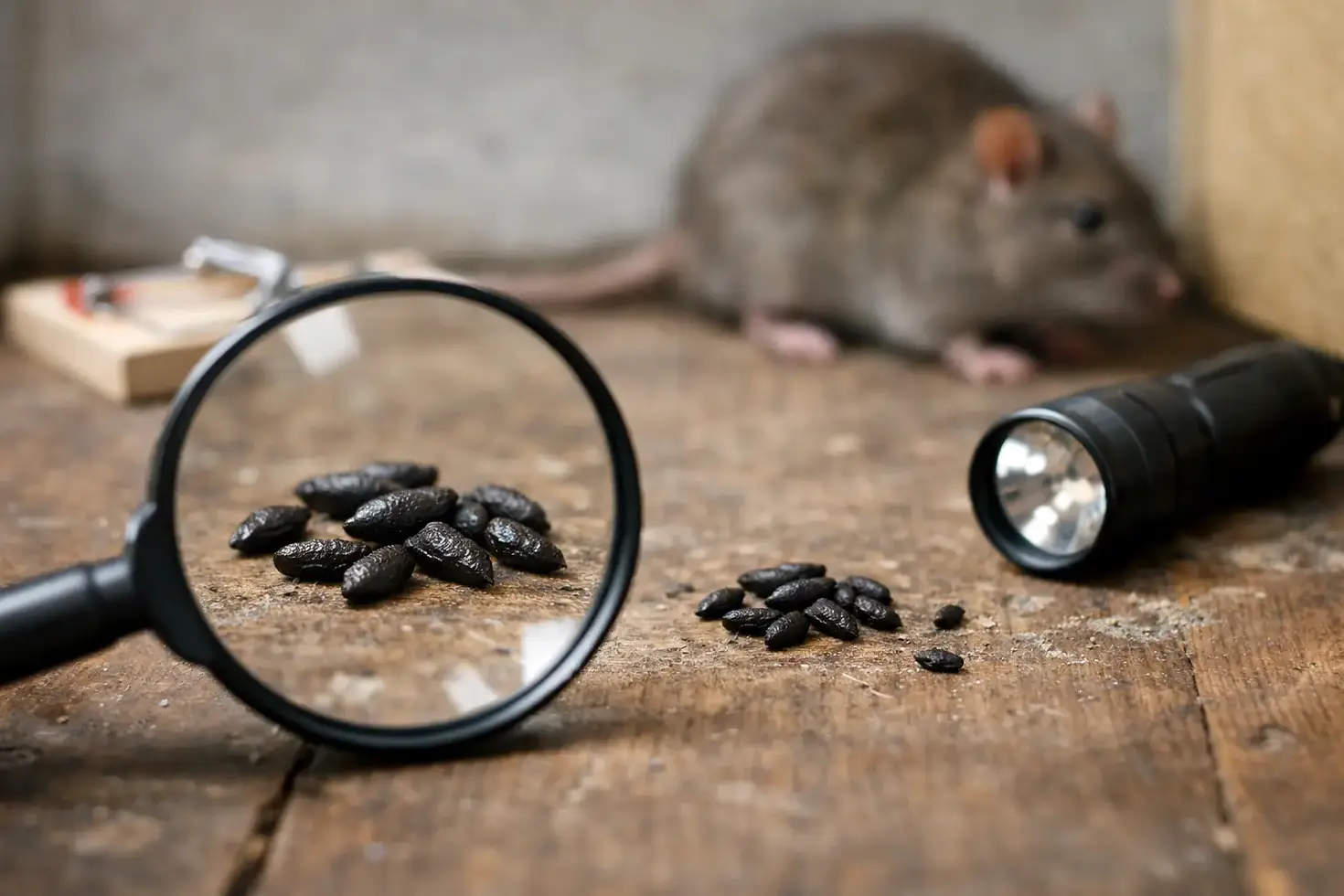
Identifying Rat Droppings: What to Look For

A few dark pellets behind the washing machine or along the garage wall can be an early warning that rats are using your property. Identifying rat droppings correctly helps you act before a small access problem becomes damage to wiring, insulation, stored food or your reputation as a landlord or business owner.
Rat activity is not always obvious. Rats tend to stay close to walls, move mostly when a building is quiet and use the same sheltered routes repeatedly. Droppings can therefore be the first reliable sign that you need to investigate.
Identifying rat droppings by size and shape
Fresh rat droppings are usually dark brown or black, moist-looking and slightly shiny. As they age, they become drier, greyer and more brittle. This can give a broad indication of whether activity is current, but it is not a precise way to date an infestation. Warm, dry lofts and damp sheds will affect how quickly droppings change.
Most rat droppings are around 12 to 20mm long - roughly the size of a large grain of rice - and are thicker than mouse droppings. They commonly have a sausage or capsule-like shape, often with tapered ends. A large number in one area, particularly where they look fresh, usually suggests regular activity rather than a rat passing through once.
Shape can vary between species and individual animals, so size alone is not enough for a firm identification. What matters is the full picture: the droppings, their location, other physical signs and the condition of the property.
Rat droppings versus mouse droppings
Mouse droppings are normally much smaller, often around 3 to 8mm long, and are more like dark grains with pointed ends. They may appear in cupboards, drawers, behind kitchen appliances and near food sources. Rat droppings are larger, more substantial and are often found along walls, under floor voids, in lofts, garages, bin areas and outbuildings.
If pellets are very small or you are only finding a few, it may be mice rather than rats. However, mixed signs can occur in older properties, shared bin stores and commercial premises. A professional inspection is the safest way to establish what you are dealing with and where the animals are getting in.
Where rat droppings are most often found
Rats prefer cover, warmth and a dependable food source. Look in sheltered, undisturbed areas rather than open floor space. In homes, common locations include behind kitchen units, beside boilers, under stairs, in lofts, garages, sheds and around pet food storage. In flats and rental properties, check service cupboards, communal bin areas and pipework routes.
For businesses, droppings are often found near stock rooms, waste storage, plant rooms, false ceilings, staff kitchens, loading areas and external drains. A single finding in a food business, care setting or hospitality venue should be taken seriously. Even where the source is outside, rodents can create hygiene concerns and compliance issues if they gain access to the building.
Outside, check behind bins, beneath decking, around compost heaps, along fence lines and beside sheds. Rat droppings around a drain cover or damaged air brick can point to a route into the property. Do not assume a rat is living only outdoors because the evidence is outside. Rats can travel between gardens, drains, voids and buildings with surprising ease.
Look for these signs alongside droppings
Droppings tell part of the story. The following signs help confirm whether rats are present and whether they are actively using a route:
Gnaw marks on timber, plastic pipes, cables, food packaging or stored materials.
Greasy rub marks on walls, skirting boards and pipe runs where rats repeatedly travel.
Scratching, scurrying or squeaking sounds in lofts, wall cavities, ceilings or under floors, especially at night.
Shredded insulation, paper, fabric or cardboard used for nesting.
Small holes near air bricks, damaged vents, gaps around pipes or burrows near sheds and patios.
A strong musky smell can also develop where rodent activity is established. In some cases, you may notice pets staring at a cupboard, wall or appliance before you see any other sign. These clues are useful, but you should avoid moving heavy appliances, lifting floorboards or reaching into inaccessible voids without proper care.
Do not sweep or vacuum droppings dry
Rodent droppings and urine can contaminate surfaces and may carry harmful bacteria. Avoid dry sweeping, brushing or vacuuming droppings, particularly in enclosed spaces such as lofts, cupboards and sheds. This can disturb contaminated dust.
Keep children and pets away from the area. Wear disposable gloves, ventilate the space where possible and use a suitable disinfectant before carefully lifting droppings with disposable paper. Seal the waste in a bag before placing it in the outside bin, then wash your hands thoroughly. If there is a large amount of droppings, a dead rodent, nesting material or contamination in a food-preparation area, arrange professional help instead.
Cleaning without dealing with the cause will not solve the problem. New droppings may appear within a day if rats still have access, food and shelter.
What fresh droppings mean for your property
Fresh droppings near food, insulation or electrical cables should be treated as an active pest issue. Rats can contaminate food, damage plumbing and chew electrical wiring. They can also exploit small building defects that become worse over time, such as broken air bricks, gaps around drainage pipes and poorly sealed doors.
For landlords and property managers, quick action also protects tenants and reduces the chance of a complaint becoming a larger maintenance problem. For commercial operators, prompt investigation helps protect staff, customers, stock and business continuity.
It is tempting to place shop-bought poison straight away, but this can be ineffective or create further problems. Rodenticides must be used responsibly, especially where children, pets, wildlife or food handling are involved. If bait is placed without finding the entry point or understanding rat behaviour, the infestation can continue around the treatment area or return soon afterwards.
The right response: treatment and proofing
Effective rat control starts with inspection. A trained technician will assess the evidence, identify likely entry points, look for harbourage and consider food and water sources. Treatment can then be matched to the site, whether that means trapping, carefully managed baiting, monitoring or a combination of methods.
Just as importantly, the property needs proofing. This might involve sealing gaps around pipes, repairing damaged air bricks, fitting covers to vents, improving door seals, securing bins or addressing defects around sheds and drainage. The best solution depends on the building and the extent of activity. A Victorian terrace, a rural outbuilding and a busy commercial unit each present different access points and risks.
At FULL GUARD Pest Control, our approach combines professional rat treatment with practical proofing advice, so you are not left dealing with the same problem again. We will explain what we find in clear terms and help you take the right next step for your home, rental property or business.
If you have found pellets that could be rat droppings, take a clear photograph from a safe distance, note exactly where you found them and avoid disturbing the area. That simple record can make an inspection faster and help get the problem sorted before rats become settled.


Comments